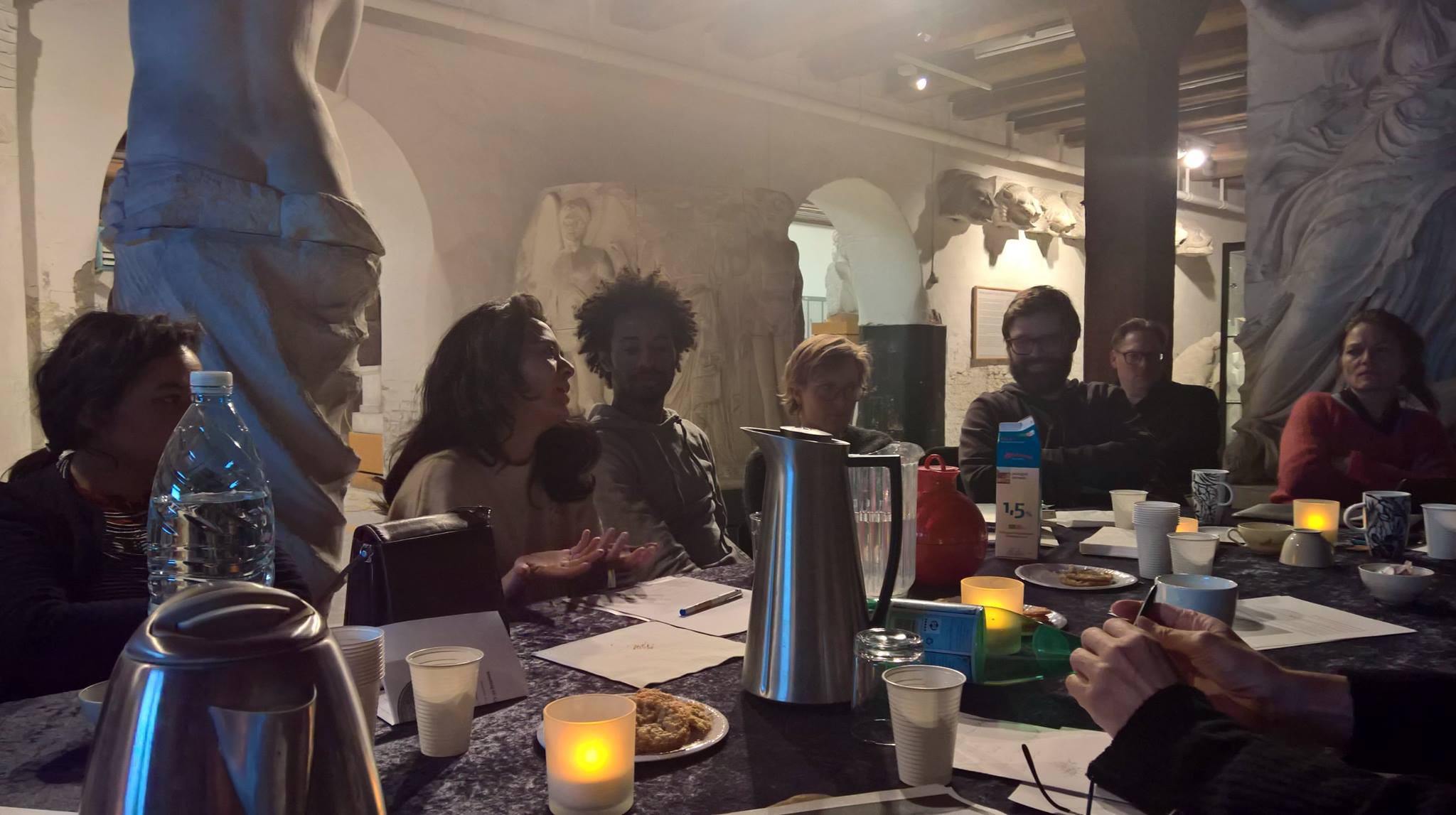
In the fall of 2016, Roskilde Museum of Contemporary Art established a Study Group on Migration. Regular meetings of 19 artists, exchange of theoretical considerations and artistic response were tackled with.
The main questions were: ‘How does the current migration challenge the idea of the nation state, borders and questions of belonging? And how can we approach this conflicted field, overcome ’othering’ and contribute to new ways of understanding ourselves and each other?’.
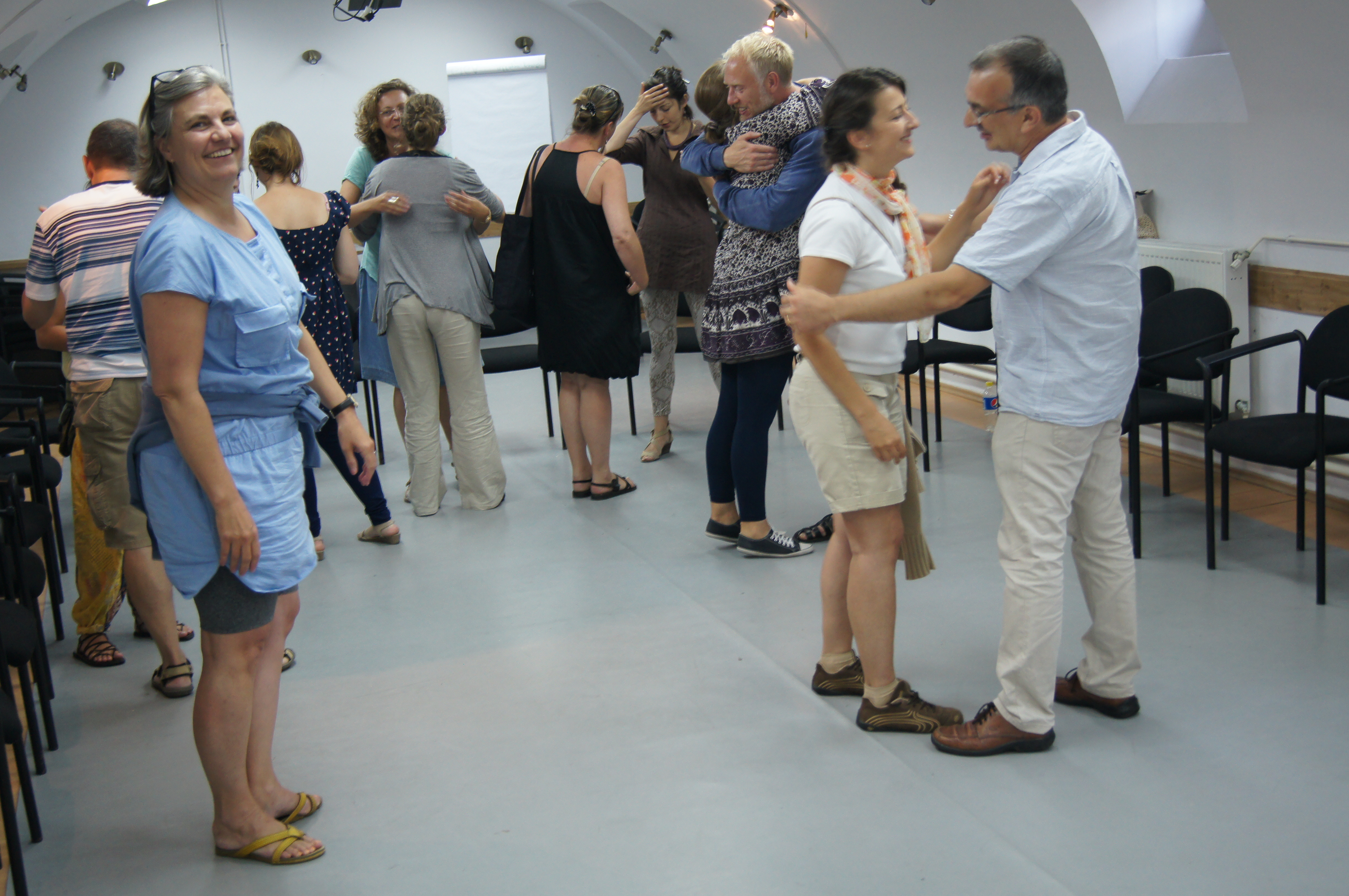
Othernessproject was present with the Nursery Rhymes performative workshop, and, at the final, open event of the series, on 21at January, with an object-personal story participatory event: an immersive experience of connection and storytelling.
Artists, researchers of the Study Group:
Ana Pavlovic
Anne Boukris
Anne Sofie Rothe Børsch
Dejene Daba
Kirstine Mose
Maj Horn
Marie Northroup
Marie Hoff
Nanna Katrine Hansen
Rita Sebestyén
Steve Edward Ross
Seda Özçetin
Seyda Özçetin
Thomas Eisenhardt
Tina Helen
Victor Vidal
Eva Perez
Facilitator: Mai Takawira, project coordinator.
Researcher of refugees and asylum seekers: Zachary White, anthropologist.
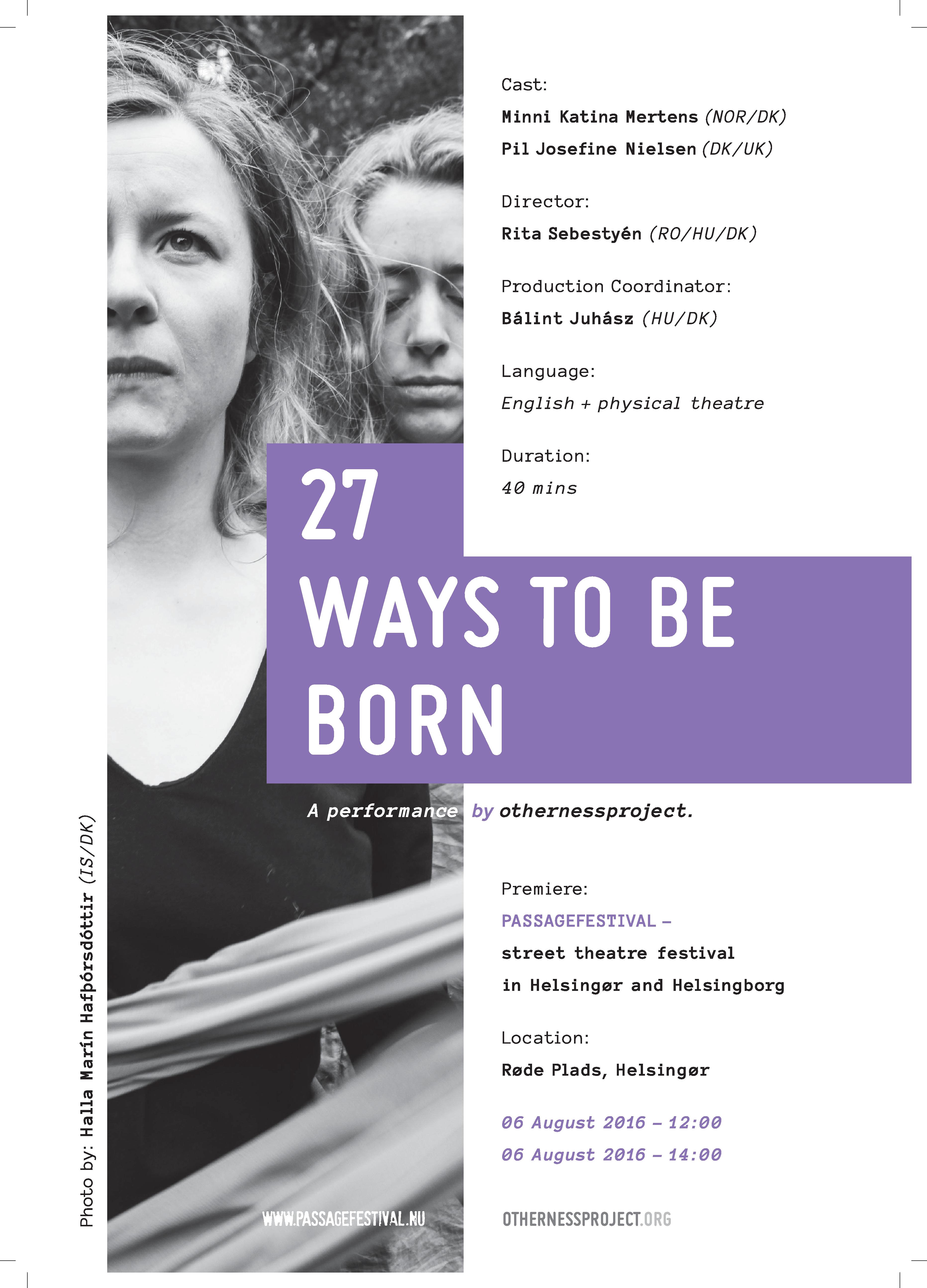
27 ways to be born is a collective drifting through stages of transition, in-between, passage.
Sensing communion and individuation, also transition states of natural/artificial, alive/lifeless, instinctual/reflective are explored together with the participants. The phase of start, initiation, and birth of a being or a process is experienced on a metaphorical level, throughout a series of mostly physical theatrical scenes that follow a simple, loose story line.
The performers invite the audience to take part in the performance according to their choice: from watching to moving, commenting, and sensing.
As an inspiration, we used birth stories collected from Africa, South-America, India, all over Europe, and always reach out and involve the local community. We speak the language of movements and senses, but also deliver shorter texts in English and some lines on the mother tongue of the performers and participants.
Trailer:
Special Thanks to:
Denis Muwanguzi (UG/SE)
Eva Perez Sanchez (ES/DK)
Ágnes Székely (RO)
The Centre for Studies in Otherness is a collaborative project between scholars primarily from the University of Aarhus, Denmark and Mary Immaculate College, Limerick, Ireland.
‘Otherness: Essays & Studies’ seeks to publish research articles from and across different academic disciplines that examine, in as many ways as possible, the concepts of otherness and alterity. As such, the journal now offers an outlet for the dissemination of such research into otherness and aim to provide an open and active forum for academic discussion. For further information on the journal, please contact the editors at otherness.research@gmail.com.
The new, special issue of the journal tackles with Otherness and the performing arts, some of the contributors being members and co-creators of othernessproject.
Contributors: Adam Czirak, David Schwartz, Azadeh Sharifi, Emily Hunka, Marco Galea, Oroszlán Anikó, Marie Bennett, Eszter Horváth
Edited by Rita Sebestyén and Matthias Stephan
Introduction
Re/shaping Otherness is the focus of the current, special issue that explores performative and theatrical representations of Otherness. Within the spaces of theatre and the performing arts, the differential bounds demarcating otherness, such as national, cultural, religious, socio-political, sexual, gender, and diasporic delineations, are continually and constantly dramatized, disrupted, negotiated, and redrawn.
In light of the heated debates on globalization and multiculturalism in recent years, new, heterogeneous inter- and cross-cultural approaches to fluid, migrant, hybrid, transcultural worlds have emerged. In this respect, the question of Otherness is vital to the quests that arise as a result of their emergence: How do we approach these new intersubjective and dialogical perspectives of identity-seeking, self-definition, indeed, community cohesion in such a milieu? In a world increasingly global yet local, uniform yet diversified, how do these perspectives complicate relations to and understandings of others and Otherness? How is the relationship between dominant and peripheral cultures, self and other, reflexively re-negotiated? In the following articles we will consider a surprisingly vast array of topics: most recurrent being embodiment, representation, participation, différance, act and reflection, and also methods of approach: ranging from theoretical analysis to essay-manifesto and performance-as-research methodology. This open and loosely waved narrative, offering philosophical, socio-cultural and artistic insights, also induces a series of quests related to Performing Arts being challenged with regards to its genre, role, socio-cultural-political involvement and responsivity/responsibility.
The exchange of gazes is the pivotal question of Ádám Czirák’s study: Becoming Someone Else. Experiences of Seeing and Being Seen in Contemporary Theatre and Performance.His study deals with the production trend based on the mutual visualization of the participants that inevitably induces a process of subjectification, in which looking at someone else is accompanied by being looked at. The relation of a new Self and the Other is embedded in these performances that transform the classical subject-object duality into a contingent subject-subject relation. Through examining, from this point of view, performance by Franco B., She She Pop and Dries Verhoeven, Czirák pints to the importance of fashioning new guidelines of a performance analysis approach, and the genre becoming crucial to consider political questions of representation.
Stemming from and leading to direct socio-political considerations, namely the refugees’ situation in a relatively tangential country like Romania – and one case in Tajikistan — thenext article raises all the questions of displacement, socio-cultural otherness, cultural geography and of representation. Based on his own research, creative processes and performances, and subsequently even the audience’s feedback, David Schwartz, artist and activist outlines a double narrative in his article: Born to Run. Political Theatre Supporting the Struggles of the Refugees; a personal, local, historical, political, cultural description of the refugees’ struggles, and the artistic and human experience of the artists and refugees taking part in the creative practice. The article offers the broadest possible horizon of performance as research: hermeneutical-descriptive methods, interwoven with socio-political considerations and a reflective gaze on his own work, leading ultimately to a complex yet by its descriptive aspect easily approachable social-artistic action research. Born in the Wrong Place as performance, Migration Stories as performance, followed by debates and the involvement of the refugees and their opinions brings up crucial questions of ‘foreignness’, prejudice and ethical questions of self-representations.
Likewise, migration and refugees’ social integration are the topics of the article by Azadeh Sharifi: Mentality X – Jugendtheaterbüro Berlin and its theatrical space for Urban youth of Color, this time shedding light on a phenomenon that both socially and artistically indicates a further step on the matter in question: post-migrant theatre. The term itself being recently coined by researchers, it expresses a phenomenon of self-empowerment, self-representation of the second generation migrant communities, who, through often cross-genre artistic forms of the performing arts and hip-hop, take in their hands the discourse on their own precariousness and transit-state in the German society, deconstruct racist narratives and occupy physical, artistic and aesthetic space through their manifestos and actions. Through festivals, own narratives and aesthetics created by Mentality X, they inevitably push critical reflection, social awareness into discourses that regard them as artistically-socially-politically decisive factors.
Roughly speaking, a manifesto can be regarded as a plan of and call for action projected into the future, often related to (and challenging) socio-political and artistic environments. By putting forward a new aesthetics, method, discourse, community, and a new artistic view that have been marginalized before, Emily Hunka, the author of the next article entitled Method in our madness: Seeking a theatre for the psychically disabled other merges the descriptive methods of existing phenomena and the cast-in-the-future gesture of the manifesto. She raises her voice for discovering the possibility of a theatre that can provide the psychically disabled young people with a space that turns the margins into a comfortable place to live and create. Operating with the significance of ‘social capital’ and ‘human capital’, also giving abundant examples from Shakespeare to Nietzsche, Kierkegaard, Schopenhauer, and the power of the creation that through the limbic resonance of the artist reframes the socially viewed oddity into works of art, Hunka provides both scientific and aesthetic considerations and challenges the socially restrictive frame of the atypical emotion/behaviour.
A historically, socio-politically and culturally representative, post-colonialist issue is addressed by Marco Galea in The Pantomime Other: Building Fences in Pantomime Performance in Malta. Starting from a historical event, more than 200 years ago, a blockade that lasted 18 months in Malta, Galea unfolds a complex network of social and cultural colonization, a hidden and many-faceted othering endured by the Maltese, condensed in one theatrical metaphor: “black skin, white masks”. Maltese and British amateur and professional theatres and their traditions – e.g. the apparently innocent action of writing a pantomime – become dangerous and harmful instruments of colonial control; the anglicized Maltese still being present in the cultural landscape of Malta: the speaking subject that describes the rest of the population as the Other, the different, the subaltern.
As opposed to the colonized representation of the Maltese in the former article, a witty, almost cunning self-representation and self-empowerment emerges from the article of Anikó Oroszlán: “Mute Hieroglyphics”: Representing Femininity in the Early Stuart Court Masques, dealing with early English actresses in the 16th and 17th centuries. Oroszlán draws our attention to the radical dichotomy between the fact that, on the one hand, the women who performed in those times were regarded as corrupt and amoral, and on the other hand, even the reigning queen was able to show herself in public, like an ‘actress’. Through civic pageants, guild plays and royal processions, posing the questions of professional and amateur theatre artists, the social status of the performers and the influence of another culture – in this particular case the Italian touring companies, the article focuses on the emergence of the body of the queen, representing royalty, but on the other hand, inevitably, the controversially regarded female performer, while tackling at the same time the metamorphoses thematized in the masques of Ben Jonson’s plays.
Theatre as a place where physicality is (also) displayed, being an emblematic metaphor of mutability and the ephemeral, is contrapuntal, yet represented in films that deal with and reveal different strata and approaches of Mozart’s otherness – closely related to the socio-cultural frame of his contemporary Vienna. Marie Bennett scrutinizes in Representing Mozart’s ‘Otherness’ in Film Mozart’s social otherness, such as his incapability to relate, while several accounts portray him as a social prodigy, as well. A predilection to the use of Turkish music as mystic, oriental Otherness, and also Otherness of nationality and class are closely examined in the films Wuthering Heights (1939), The Truman Show (1998), The Heart is a Lonely Hunter (1968), and Kind Hearts and Coronets (1949), in strong interdependence with the dramaturgy of the music used in them, is examined in this paper on Mozart’s Otherness.
Eszter Horváth’s The Other and its Double closes this special issue, dealing with questions of Otherness and bodily representation, starting from Rimbaud’s metaphor: ‘I is another’. Like in most of the previously mentioned articles, questions of corporeality, representation, discourse creation and emergence come up as main topics. In this last article the theoretical, mostly phenomenological approach of Otherness in performing arts summarizes and encapsulates most theories that the issue tackles: repetition, re-presentation, difference (Deleuze); human bodies being socially constructed (Butler), reconsiderations of corporeality in the discourse of the Other, as well as the actor seen as a conscious body, acting upon its constitutive differences.
Conception: Lars Henning, Rita Sebestyén, Louise Søeborg Ohlsen
Workshop leaders: Lars Henning and Louise Søeborg Ohlsen
Presentation: Rita Sebestyén
‘Foreigners!
Your clothes are not Greek. Foreign robes of finely woven fabric… covered in gems… nothing like ours!
Where are you all from? No women from Argos or the rest of Greece wears such clothes.
You must be brave, coming here unannounced like this, with no friends and no one to guide you!
Astonishing!
Ah! I see branches on the altars and by your sides. That tells me that you are suppliants and you seek protection from me but that’s all that a Greek can gather from that. I’ll have to make my own assumptions about everything else, unless you tell me in your own words the rest of your story.’
(Aeschylus: Suppliant Maidens, transl.: George Theodoridis)
Organized by the research program: “Art, Culture and Politics in the ‘Postmigrant Condition’” (funded by FKK/Danish Council for Independent Research) in collaboration with CISPA (Copenhagen International School of Performing Arts), we offered a workshop as a part of Symposium on Language and Migration, which incorporated researchers from different universities in Denmark and independent researchers from Germany within the fields of International Actor Training, Linguistics and Art, Culture and Politics in the Postmigrant condition.
As a continuation of and inspired by the Otherness Dialogues workshop that we held in Miercurea Ciuc/Csíkszereda, RO, in August, 2015, for cultural operators, this workshop aimed to give the participants a body-mind-soul experience of language. We worked with the first play on migration: The Suppliant Maidens by Aeschylus and through this text implicitly experienced both the view point of the migrant and the “settled”.
Through different exercises, starting with the breathing, communicating with organic sound, and de- and reconstructed components of a few lines from the Ancient Greek text, the participants investigated engaging in a dialogue in a totally alien language, where nevertheless the sheer reciprocated effort of trying to bridge the gap to the other through embodied sound and (alien) language brought about moments of wholeness and communion.
Lars Henning, artistic director at CISPA
The base of the workshop for me as a participant from the actor side was a short excerpt of AESCHYLUS’ “SUPPLIANT MAIDENS” in English. As a preparation I learned the text by heart and researched the plot of the play. In contrast to that, we worked on an excerpt in the Ancient Greek original text and language during the workshop, dissecting it from the base of just one word and its individual syllables up to using the whole excerpt in Ancient Greek. One thing that strikes me at the first stage of non- or deconstructed language is that connection with the partner, listening and responding, communication is possible without a common, spoken, language. Or simply just through body language. Be it socially constructed patterns of behaviour or instinctual behaviour patterns.
Moving on through using more and more of the Ancient Greek, even though still not understandable on an intellectual level, it becomes apparent that the sound and body of the language still carry a meaning and emotional depth. There is a certain power and majesty carried through by the way the language begs to be embodied, spoken, regardless of comprehension by the speaker.
Constantin Gindele, 1st year student
It is impressive how much language reflects the culture There are some important differences between Greek language and English or Scandinavian languages in the feeling that is created while you speak the words concerning how direct a language is. I have thought about that before, but it became even more obvious during the workshop. Greek is my mother tongue, so I could not be certain if I feel that because I express myself better in Greek or because the language itself is more direct. After having some discussions with other participants I realised that they had the same experience without even knowing exactly the meaning of the phrases. Another difference that I observed is that in Greek it is easier to refer to something without using all the time the object we are referring to, while in English we always have to refer to the object we speak about. This gives more freedom in Greek to create new expressions. Probably, that is why poetry is so different in Greek than in North European and western languages.
In addition, the communication between us (the participants) in an (almost) foreign language was exciting because the body language and the movements were significant in order to have a dialogue. I would love to know more about the concept of otherness as well, since I found it quite important for human and society development from a cultural and psychological point of view.
The series Otherness Dialogues held a workshop in Miercurea Ciuc/Csíkszereda, RO on the 1-2 August, 2015, for cultural operators, community developers and cultural managers.
Starting from Shakespeare’s The Merchant of Venice, Shylock’s monologue, the participants went through an experience of sensing foreign languages – the monologue being performed in English, Danish, Hungarian, Romanian, Maltese and Lusoga language – , the embodiment of the sound and language, a personalisation of the monologue by rewriting it, and took part at interactive lecutures on language and community, body and community, on concepts of colonisation and decolonisation.
In the following we publish excerpts from some of the participants’ feedbacks (English translation offered partly):
Amilyen rövid volt ez a két nap, pont annyira intenzív. Nem mondom, hogy űrt hagyott maga után, de mégis szeretném, ha bármilyen formában tarthatnám Veletek a kapcsolatot, segíthetném a munkátokat. Nekem misszióm, hogy energiákat szabadíthassak fel az emberekből, pont ezért törekszem a belső egyensúlyra, ami képessé tehet a kifele való figyelésre. Ebben a dologban erősített meg Lars, aki a kisugárzása és odafigyelése által nagyon inspiráló hatással volt rám. Egyszer én is szeretnék ennyire jól “facilitálni”. Ritának a pozitív kisugárzását sem tudnám elfelejteni, ahogy a Marco és Denis nyitottságát és csodálatos anyanyelvét sem. A mi régiónkban még mindig nagyon erősek az etnikai feszültségek, nagyon jó volt beszélgetni erről a témáról más perspektívából, annak egy mélyebb értelmezésében. Azóta is gondolkodom a másság témáján (bár említettem nektek, számomra ilyen önmagában nem létezik).
These two days were as short as they were intensive. I wouldn’t like to say that I felt empty after it finished but I do hope that we can keep in touch in some way, and I would also love to help your work.
In our region ethnic tensions are still very present, so it was helpful to talk about these issues from a different perspective and with a deeper understanding. I am still thinking about the question of otherness – although, as you may remember me saying, I don’t believe such a thing really exists.
Bálint Erzsébet (Zsé)
According to Heidegger being or existing is not self-evident at all. We don’t have memories or experiences from a “pre-being” time. Our lives seem to be the only pure condition that exceeds everything else, forms, structures, even reason. But all that self-awareness becomes clear in our encounter with the “other”. In this encounter we are forced to give shape and meaning to the “other” and in the same time to our “self”, we have to articulate it via language, gestures or movement. This isn’t self-evident at all. And it is not easy either. This workshop made this “unnaturalness” visible to me. It became clear that these encounters, with others and with ourselves, reach far beyond linguistic terms. The effort of make your own “being” visible to the other, in a language unknown to you, to reach out to that other and then that other trying to reach back at you kind of obliterates the boundaries of “otherness” and “selfness”. It’s a perfect communion. Sensing my partner in its sheer frail existence far beyond utterances, far beyond meaning and then to see each other, as we are, in our pure “humanness”. Cathartic. Maybe we do have remnants of those “pre-being” times after all.
Ágnes Benedek
Bevallom, nem teljesen sikerült kikapcsoljam a szakmai énem a folyamatok szemlélésénél, nagyon kíváncsi voltam amúgy is a módszerre magára. Amint a zárókörnél is megosztottam, nekem nagyon tetszett az az irány, ahogy egy másik ember bőrébe bújva (Shylock), őt megismerve és megértve jutottunk közelebb saját magunk sokkal mélyebb rétegeihez. Legalábbis én ezt tapasztaltam. Ehhez viszont kellett az az önismereti szint, ami úgy gondolom mindenkiben megvolt a csoporton belül, szerencsére. Kicsit talán túl “színészes” ízű volt, de nagyon tetszett Lars-nak a módszere. Elgondolkodtam kicsit, hogy hosszú távon vajon milyen hatása van az ilyen típusú workshopoknak, projekteknek, és ilyen szempontból viszont kicsit borúlátóbb vagyok. Merthogy alapvetően nagyon nyitott, széles látókörű, önismerettel rendelkező, empatikus emberek a résztvevők, ilyen alapanyaggal aránylag egyszerű dolgozni, de sajnos a változás mértéke nagyon alacsony. Igazi kihívás ebben a témában olyan célcsoporttal lenne dolgozni, akik jóval szélsőségesebben gondolkodnak ezekről a témákról, és bennük megmozdítani valamit az elfogadás irányába.
I wonder what the effect of these types of workshops and projects can have on the long run – I must say, I am a bit pessimistic. These participants were all very open, people with a breadth of view and empathy, who also have good self-knowledge. With them it was easy to work with, although I found the change that one can achieve to be too little. The real challenge would be to work with people that have a way more radical view on these topics and to see whether it is possible to help them towards a greater acceptance.
Haba Tünde
The workshop had a very good dynamic as games, practical exercises and theoretical insights were well balanced. The facilitators created the context of experiencing my own and the other participants` otherness and sameness at the same time. The workshop kept me fully concentrated and meant a very intensive togetherness. It also offered the chance of challenging my own inhibitions. On the whole, it was a liberating experience.
Demény Enikő
Különleges élményt nyújtott nekem ez a workshop, az elsőre értelmetlennek tűnő gyakorlatok később mély nyomokat hagytak bennem, amikor a szavaknak már nem csak a felszínes értelmére összpontosítottunk. Nagyon érdekes volt a különböző nyelvek, kultúrák találkozásánál rájönni a másságban való közösségre. Jó volt megtapasztalni a közösség élményét, érezni a bizalmat, amit a megnyíló egyéniségek megelőlegeztek. Nagyon jól kigondolt volt a workshop felépítése, ahogy egymásra épülve, egymást kiegészítve következtek a foglalkozások. Köszönöm nektek hogy részt vehettem ezen a workshopon és ilyen élménydús hétvégét tölthettem el értékes emberekkel.
I found it very interesting to experience a sense of community in the otherness that the different cultures and languages created. It felt good to be together, to feel the trust as we open up to each other. I thought the workshop was well-thought-out, with the newer excersises always completing the previous ones. I am grateful to have attended the workshop and also for the eventful weekend that I got to spend with these exciting people.
Tánczos Viktória Anna
Izgalmas volt a két nap. Felkavaró is – gondolom ez is a projekt lényegéhez tartozik. Valóban kimozdított a komfortzónámból, de valahogy mégsem úgy, hogy nyitni tudjak, de mégis valahol annak határán éreztem magam. Talán ha több időnk lett volna, sikerült volna átlépnem ezt a határt. Amit a hangokkal, idegen nyelvekkel, mozgással műveltünk, az nagyon tetszett. Szeretem azt, mikor az artikulálatlan hangok, a szabálytalan mozgás segítségével olyan gesztusok, arckifejezések, hangok és mozdulatok rajzolódnak ki, válnak jelentéshordozóvá, amelyek meglepnek, amelyeket korábban nem láttunk, mintha most először nyernének kifejezést. A bennünk levő ismereten lehetőségeket villantja fel számomra, illetve azt, hogy ezek a lehetőségek akkor tudnak felszínre kerülni, ha képesek vagyunk elengedni magunkat, ellazulni, ha bizonyos értelemben merünk kockáztatni.
I loved it when inarticulate sounds and irregular movements helped create surprising gestures, face expressions, sounds and moves, how these all became significant, like we haven’t seen them before, like we are expressing them for the first time. For me this showed the unknown possibilities in ourselves and also that these possibilities can only emerge if we are able to let go, to relax, to take risks.
Túros Eszter
There was one exercise when I had to tell to somebody what I really feel with the help of a Shakespearian text, and I just invented something. I lied. I lied to my partner, who was completely unknown to me. It seemed that she did not resonate with what I said. I tried to lie again, using all my acting skills. I wanted to see if I could break the rules of the game. It did not work. So I decided to be truthful. And then it worked. It is not only children that are vulnerable and intelligent. Grown-up people are sensitive, too. In arts, games and even in small everyday actions you have to be true, deep and brave. I am thankful for all the Others who have accepted me. Rita and Othereverybody! Yes, I will trust my ideas (to bring Bridge Theater to OP as Romanian participant), my vocations (to create, play and learn) and my hopes (to help make the world better, to meet nice people, to help cultural associations survive in Romania yeahyeah). Let’s create more ground-breaking experiences and projects together, and let’s play!
Barabás Réka
Színház, mert csak távoli szemlélő vagyok. Játék, mert egyre kevesebb van belőle. Közösség, mert kisebb, nagyobb csoportok tagjai vagyok. Kommunikáció, mert egyre zárkózottabb vagyok. És igen, még van a nyelv. Az eszköz.(!?)
A játékos lazító gyakorlatok jól jöttek ebben a merev karót nyelt világban. A Shakespeare idézet hatott. Zsidó. Muju, lusoga nyelven. Mi sül ki belőle? Mondom az idézetet, többször, távolodok, hangom hallatom, figyelem a belső rezgést, veszem a ritmust, és lassan, lábujjhegyen jön az indulat… még én is meglepődök…
Nem a szöveg értelmére összpontosítok, a hangzásra, a belső rezonálásra … s akkor keverem a nyelveket, kezdem megszemélyesíteni, újra ízlelni…magamra szabni. Nyelvet választani. Leírni.
Ez az a szembenézés ami kell. Szükséges mindenkinek.
És akik bevállaltuk ezt a hétvégét, szerintem sokunknak volt már lelki élményben része, szociálisan érzékenyebbek vagyunk, és nemcsak önismeretre törekszünk… Mert a másságot ebben az ideális környezetben könnyű elfogadni, ilyen nyitott személyekkel, de kilépve az ajtón…ott mutatkozik meg igazán.
All of us who have participated in this workshop are people who had previously taken part in spiritual experiences. We are socially sensitive who are searching for more than just self-knowledge… In an ideal setting such as this was, with people this open, it was easy to accept otherness – the real work starts when one leaves this place…
Rita, thank you for your gentle firmness. I enjoyed the Western, loose perspective that Lars represented, and it was nice to see how Marco as a presenter was also an active part of our work. Denis, thank you for your openness.
I tried to leave behind all of my former experiences, preconceptions and prejudices when I signed up for this workshop. I was happy to see that we were all open and brave. Together we formed a connection based on trust, although we didn’t even know each other. I didn’t think this was possible, but I’m certain now that the next time we meet, we will be able to pick it up from where we left off. Thank you.
Nagy Enikő
Hatalmas kíváncsisággal, izgalommal készültem a műhelymunkára. Már az elnevezése is érdekesnek tűnt, eddigi létem nagy részét ugyanis többszörös kisebbségiként éltem meg. Csíkszeredában vallási kisebbségiként – református vagyok -, Budapesten nemzeti kisebbségiként – erdélyi vagyok, Bukarestben úgyszintén – erdélyi magyar vagyok… Meglepett a résztvevők sokszínűsége, a szó szoros értelmében is. Lars rácáfolt eddigi „északi” előítéleteimre, kedvessége, jókedve a rideg hétköznapjaimban is jól esnének. Marconak a tisztánlátása, a kérdésfelvetései, határozott csoportos vezetése, míg Denisnek a kreatív játékai, őszinte kacagása tetszett. Ritának a humoros beszólásaiért, a kedvességéért, az egész létéből sugárzó derűért vagyok hálás. Csoporttársaimnak meg mindenért. Azért, hogy velem együtt képesek voltak ugrálni, grimaszkodni, üvöltözni, rúgkapálni, nevetni és sírni. Néhányukat igazán nagyon közel éreztem magamhoz. Jó volt két napra kiszakadni megszokott világomból, jó volt új, ismeretlen emberekkel találkozni, játszani, rácsodálkozni hasonlóságainkra vagy épp különbözőségeinkre.
As I have lived most of my life as a person belonging to multiple minorities, the title of the workshop itself seemed interesting for me. I belong to a religious minority in Csíkszereda (I am protestant), I am considered an ethnic minority both in Budapest (I am from Transylvania) and in Bucharest (I am a Hungarian from Romania)…
It was surprising to see how diverse the participants of this workshop were. Lars made me rethink my preconceptions about Northern Europeans: I could use his kindness, cheerfulness and warm-hearted attitude in my everyday life. I liked how Marco was perspicacious and firm when leading a group and also the way he posed his questions. I enjoyed the honest laughter and the creative games of Denis. I am grateful for Rita’s funny comments, her kindness and for her all-round bright personality. I am grateful for everything my colleagues had offered me – that they were eager to jump around, pull faces, shout, laugh and cry with me. I felt quite a close connection to some of them.
I. Levinas on the Other; Responsive phenomenology of the Alien Introduction to Lévinas
1. Emmanuel Levinas: The Face; Responsibility for the Other (excerpts from E. Lévinas: Ethics and Infinity. Conversation with Philippe Nemo, trans. Richard Cohen.) Introduction to Waldenfels
2. Bernhard Waldenfels: From Intentionality to Responsivity (excerpts)
II. Derrida on the Foreigner Introduction to Derrida
3. Jacques Derrida: Foreigner Question: Coming from Abroad / from the Foreigner (in: Derrida, Jacques and Anne Dufourmantelle: Of Hospitality, Stanford, Stanford UP, 2000)
III. Gadamer on hermeneutic experience Introduction to Gadamer
4. Hans-Georg Gadamer: The concept of experience and the essence of hermeneutic experience (excerpt, in: Hans-Georg Gadamer: Truth and Metod, Continuum, London-New York, 2006)
IV. Recognition and Otherness Introduction to Honneth
5. Axel Honneth: Recognition and Moral Obligation (excerpt, in: Social Research, 1997, 64/1) Introduction to Taylor
6. Charles Taylor: The Politics of Recognition (excerpt, in: A. Gutmann (ed.), Multiculturalism: Examining the Politics of Recognition, Princeton, Princeton University Press, 1994)
V. Žižek on the Other and Multiculturalism Introduction to Žižek
7. Slavoj Žižek: Neighbours and Other Monsters. A Plea for Ethical Violence (excerpts, in: Slavoj Žižek, Eric L. Santner, Kenneth Reinhard: The neighbor: three inquiries in political theology, University of Chicago Press, 2005)
8. Slavoj Žižek: Multiculturalism or the cultural logic of multinational capitalism? (excerpt, in: New Left Review. I/225, September-October 1997. http://www.egs.edu/faculty/slavoj-zizek/articles/multiculturalism-or-the-cultural-logic-of-multinational-capitalism/)
VI. Sociology of strangehood/otherness Introduction to Schütz
9. Alfred Schütz: The Stranger: An Essay in Social Psychology (excerpt, in: American Journal of Sociology, 1944, 49/6) Intorduction to Bauman
10. Zygmunt Bauman: From Pilgrim to Tourist – or a Short History of Identity (in Stuart Hall and Paul du Gay eds., Questions of Cultural Identity, London: Sage, 19-36.)
In cooperation with: GroundFloor Group and Játéktér/Playing Area
Paintbruch Factory
26-27 October 2014
A two-day workshop was divided into three parts: one part consisted of movement exercises, meant to experience both the working of a community and the non-verbal elements related to the theme.
The designers and coaches of the movement elements were the actor Ferenc Sinkó and Ildikó Ungvári Zrínyi, university professor the Tg-Mures University of Arts.
The second part included the evocation of personal stories about birth and their discussion moderated by Kinga Boros, assistant lecturer at the Tg-Mures University of Arts.
The third part of the workshop was a performance lecture constructed on a text by Slavoj Zizek, by Attila Szigeti, lecturer at the Faculty of Philosophy of Babes-Bolyai University. Imre Ungvári Zrínyi, lecturer at the Faculty of Philosophy of Babes-Bolyai University moderated and summarized reflections on the event. Sándor Sajó, lecturer at the Faculty of Aesthetics of ELTE, Budapest reported about his participation at the IETM meeting in Sofia, where he represented the project. Rita Sebestyén from Babes-Bolyai University and Anikó Varga, editor-in-chief of Playing Area, moderated the discussion about possibilities of cooperation with institutions.
Three days of workshop, symposium, two special blocks for young researchers and also two performances were comprised into the Gogol in Cluj/Cardiff event between 21-23 March. The first international, practice-based research oriented event of the Representations of the Other project has come to life as an interwoven endeavour of the Gogol InterPlayground project – a rhizomatic, world-wide growing network that encourages the use of drama as a tool for social transformation –, the GroundFloor Group from Cluj (Romania), producer of cutting-edge performances in the Paintbrush Factory, this latter serving as a venue for this event as well. Organization and professional support was also assumed by editors and contributors to the Játéktér/Playing Area theatre periodical.
Institute for Regional Development, o.p.s., Prague (the Czech Republic)
FOUNDING MEMBERS in 2014/15:
Sisso ARTNER (HU): journalist, author, editor, critic of theatre, dance theatre and pop music. She is member of Lábán Jury, also teaching journalism and communication at (PTE), Pécs University, at ZEN project.
BATARITA (HU): choreographer, dancer, director, teacher, director of the KINJIKI International Performing Arts Festival in Budapest. Since 2000 she has her own dance company, she has worked in Singapore, Romania, Slovakia, Poland, Bulgaria, Serbia, Thailand, South Korea, Japan, Austria, Germany, Ecuador and Thailand.
Åse Eliason BJURSTRÖM (SE): drama teacher and lecturer in education at the Göteborg University. For the last twenty years she has worked with drama in intercultural network settings, mainly in East Africa and Sweden, and she has co-authored a number of articles and book chapters in this subject.
Adam CZIRAK PhD (GE): wrote his dissertation on participative practices of looking in intersubjective based art. Currently he is assistant professor at the Department for Performance Studies at the Freie Universität Berlin. His research focuses on aesthetics of contemporary theatre, visual culture, psychoanalysis, and performance art in the Eastern European Neoavantgarde.
Melanie DREYER (US): director, actor, translator, teacher and producer. She specializes in multilingual theater projects and has directed over fifty productions nationally and internationally. More about her work may be found at http://www.melaniedreyer.com.
Réka DUNKLER (RO): dramaturg, librarian, teacher, cultural organizer and web editor. She has worked as a dramaturge at several award winning theatre productions and was co-organizer and co-worker of international theatre festivals in Romania.
Kinga KELEMEN (RO): cultural manager working with several NGOs in Cluj. She is founder and director of GroundFloor Group, a contemporary dance association, producer of dance and theatre performances and exchanges, and an International Contact Improvisation Festival.
MártaMINIER (UK): Lecturer in Drama at the University of South Wales. Her main research interests include European drama with a special emphasis on Central and Eastern Europe; translation studies; adaptation studies; dramaturgy; stage and screen biography; Shakespeare studies.
Lilla PROICS (HU): has been writing reviews, essays, interviews, tvmonitoring material for more than fifteen years, and she works for the independent Tilos Rádió.
Sándor SAJÓPhD (HU): philosopher and in some sense a poet and a writer too. Currently, he is assistant professor at Eötvös Loránd University Budapest (his Habilitation is in progress). He feels close to various philosophers like Kant, Hegel, Kierkegaard, Nietzsche, Husserl, Heidegger, Merleau-Ponty and Deleuze. For different reasons, to be sure.
INSTITUTIONAL PARTNERS
The Centre for Studies in Otherness(DK) is a collaborative project between scholars primarily from the University of Aarhus, Denmark and Mary Immaculate College, Limerick, Ireland. The Centre works to initiate vigorous and productive interventions into nominal areas of otherness as a site for critical, socio-political, cultural, and literary exploration.
Diasporic Genius (CA) is grounded in the creative process and the development of creative capacity and agency, in individuals and communities. It brings the impact strategies of artists (and scientists, business leaders, teachers and innovators in every sector): http://diasporicgenius.com/
European Theatre Collective (FI) is bringing artists from many diverse cultural backgrounds together to create new and exciting artistic work, strengthening both the Finnish artistic community and the international artistic community with every collaboration.
The Theatre Studies Department at the University of Malta (MT) specializes in a number of different aspects of theatre scholarship, including physical theatre, musicality in theatre, the Russian twentieth century, Baroque and postcolonial theatre. Further information about the department can be found at http://www.um.edu.mt/performingarts/theatre.